Reading seizures from a single EEG channel
A Graph Neural Network pipeline that turns one channel of brain activity into a graph, and finds every seizure in the test set. Built at IIT Delhi, published as a first-author paper.
- Role
- First author · modelling, experiments, manuscript
- Platform
- PyTorch research pipeline
- Year
- 2025 – 2026
- Stack
- PyTorch, GCN, SVM, Data augmentation, NumPy, scikit-learn
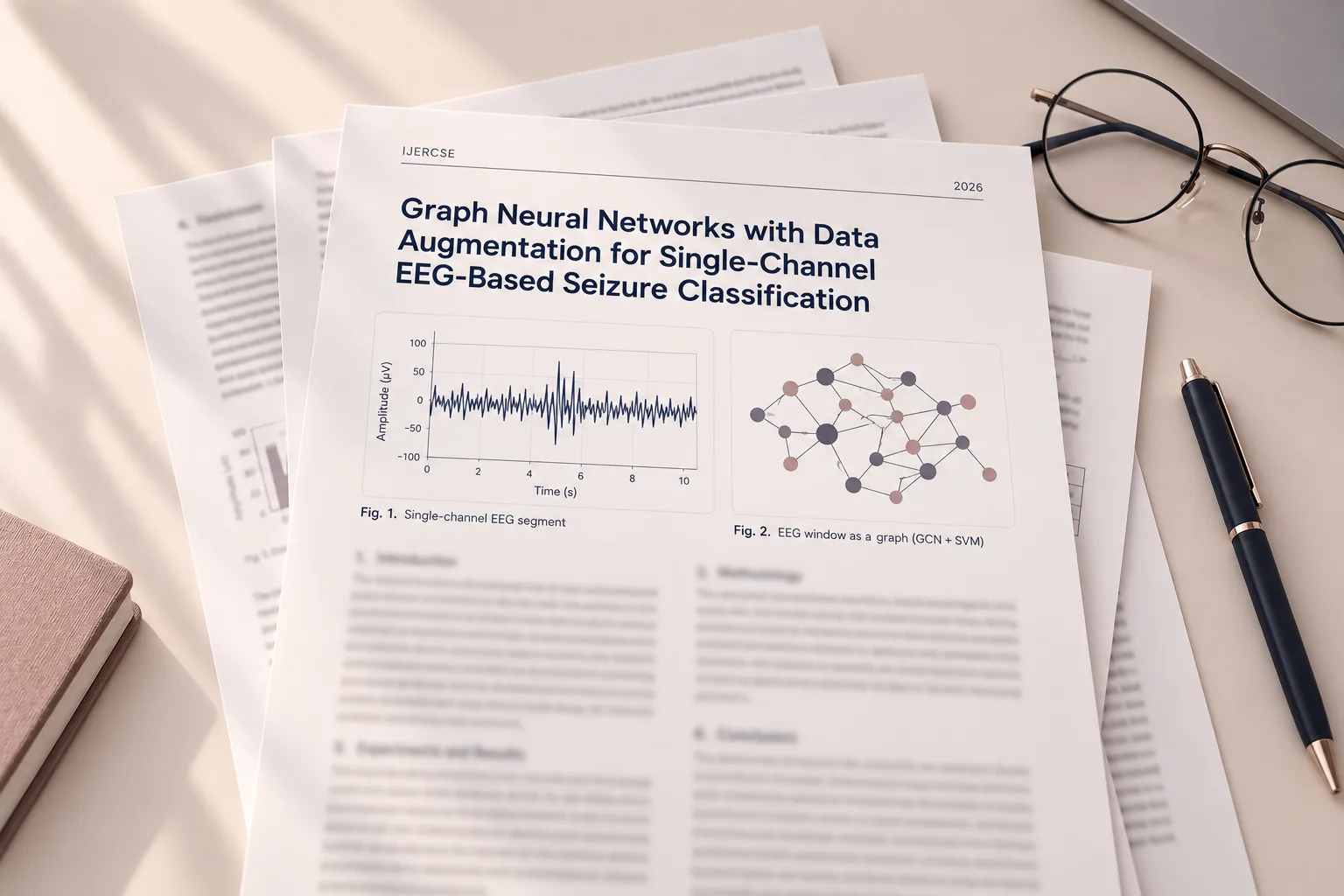
Where this started
Hospital EEG uses many electrodes. Wearables and home monitors often record just one. The research question at IIT Delhi's Department of Electrical Engineering, under Prof. Tapan Kumar Gandhi: can a model detect seizures well when all it gets is one channel, and very few labelled seizures?
What made it hard
- 01One channel carries far less spatial information than a full montage.
- 02Labels were few, and uneven across classes. Seizure windows are rare by nature.
- 03The lab wanted models it could read and change, not a black box behind a cloud API.
From one channel to one decision
Step through the four stages. Each frame is drawn live from a synthetic signal, so you can see the idea rather than take it on trust.
How it came together
- 01
Frame the signal as a graph
Each EEG window becomes a graph, so the model learns from how points in the signal relate to each other, not only from their raw values.
- 02
Grow the training set
Data augmentation added extra training samples, so the minority seizure class stopped being drowned out.
- 03
Learn, then separate
A Graph Convolutional Network learns a representation of each graph. An SVM draws the final line between seizure and non-seizure.
- 04
Compare against hand-written baselines
CNN and RNN/LSTM models were written from scratch in the same pipeline, so every comparison ran on equal footing.
- 05
Write it up
Drafted the manuscript as first author of three, with Prof. Gandhi. Published in IJERCSE, 2026.
Choices that shaped it
Sensitivity over headline accuracy
In seizure detection a missed seizure costs more than a false alarm. The model was judged first on sensitivity, and reached 100% on the test set.
GCN + SVM instead of one big network
With little data, a learned graph representation plus a margin-based classifier generalised better than training a deeper end-to-end model.
Code the models, don't only call them
Writing GCN, CNN and RNN/LSTM by hand made every layer inspectable, which is what the lab asked for.
The publication

The result I'm proudest of isn't the 99.25%. It's the 100% sensitivity on data that was small and lopsided. Next I want to test the pipeline on longer, noisier recordings from wearables, where single-channel EEG actually lives.
Ask-My-AI, a recruiter's assistant