Trip Portal, one product, two apps
A travel product split into an admin app that runs the business and a customer app that sells the trips. Two Flutter apps, released together.
- Role
- Flutter developer, Cipher Craft
- Platform
- iOS & Android, two apps
- Year
- 2025
- Stack
- Flutter, Dart, REST APIs, Bloc, iOS, Android
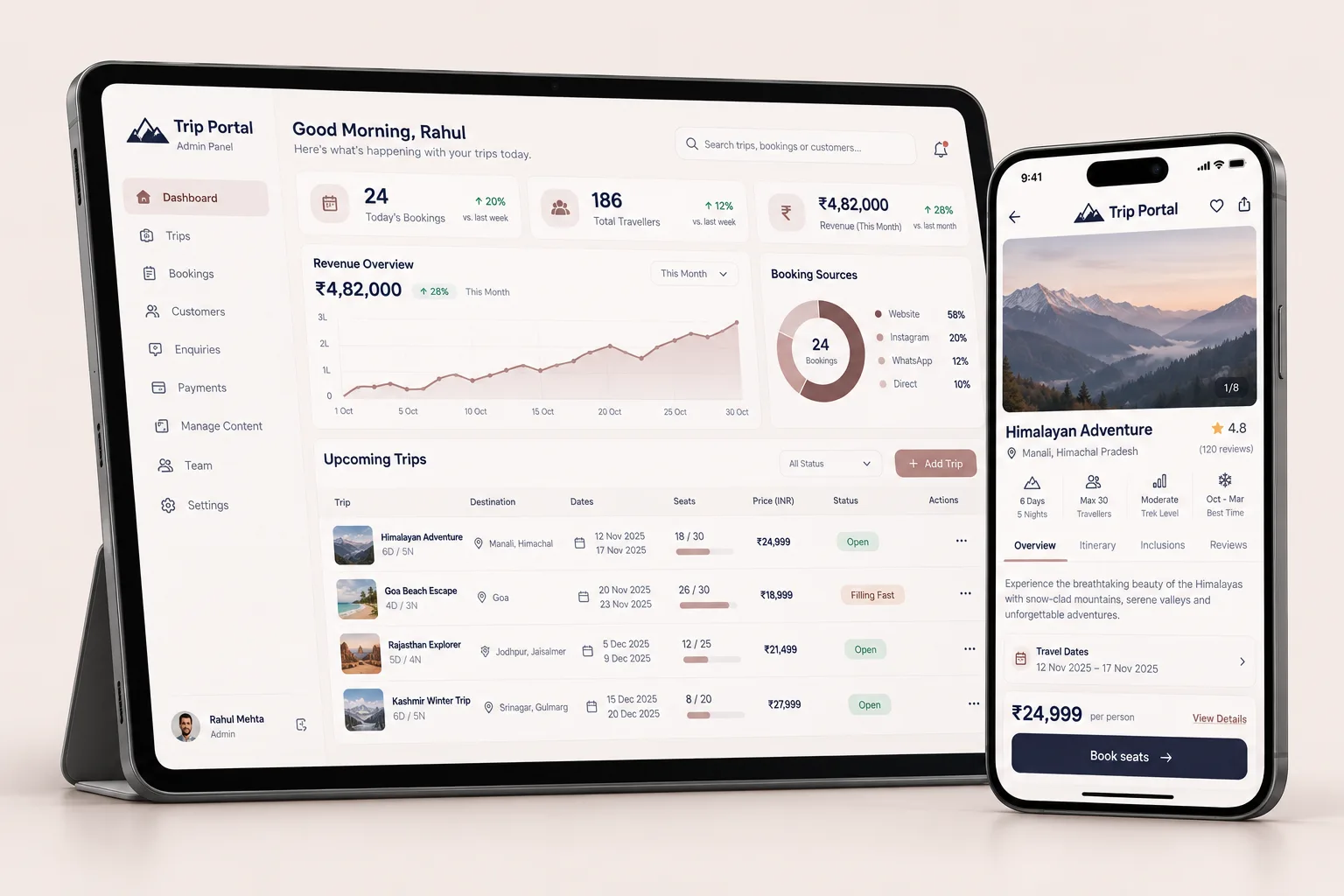
Client apps under NDA. Screens are illustrative recreations with sample data.
Where this started
A travel company needed staff to manage trips, bookings and customers, while travellers needed a simple way to browse and book. One app for both would have served neither.
What made it hard
- 01Two audiences with opposite needs: dense control for staff, calm browsing for travellers.
- 02Both apps had to stay in sync with the same bookings, on a tight timeline.
- 03Delivered while other client apps were also due.
How it came together
- 01
Split by role, share the contract
Two separate Flutter apps on one REST API, so changes in one never break the other.
- 02
Admin: everything at a glance
Trips, seats and bookings in dense, scannable lists built for daily operations.
- 03
Customer: one trip at a time
Big imagery, clear prices and a short path from browsing to booking.
Choices that shaped it
Two apps, not one with modes
Separate apps keep each one small, fast and easy to review in the stores.
Shared models, separate UI
Data models stay in step across both apps while each UI is free to fit its user.
Splitting the product was the most important design decision, and it was made before any UI. Sometimes the best interface is two interfaces.
Reading seizures from a single EEG channel